New Track Record

IndyCar Blog

Archive for the tag “Auto Racing”

IndyCar’s Endless Summer

As the end of summer looms on the horizon, I have been listening to the band that has defined summer for me through the years.  That’s right, nothing says “summer” like America’s Band, The Beach Boys.  And wouldn’t you know it, it seems like their songs have something to say to IndyCar.  So get out that scratchy copy of Pet Sounds and drop the needle.  IndyCar’s Endless Summer is here, courtesy of your host with the most, New Track Record.

“Fun, Fun, Fun”  Really, did you think our trip through the summer could start anywhere except America’s playground for the rich, Nantucket?  In the song, our teenage girl is driving her daddy’s T-Bird when she should be doing something else.  Poor, privileged Jay Penske was standing on the sidewalk in one of America’s richest enclaves when he was accosted by a simple bartender for urinating in the street.  The horror.  All of IndyCar hopes he can recover from this tawdry display of the rabble trying to take a picture of the rich and famous answering the call of nature.  In today’s political climate, the rich should be pissing on the middle class with impunity.  Accountability is for the poor.  Of course, what makes this story delicious is that Jay Penske owns the gossip website hollywoodlife.com, which specializes in covering the sordid affairs of the rich and famous.  Funny, I could find nothing about him on the website.  It seems rival gossip site TMZ has no such qualms.  Go here to see their article.

“All Summer Long”  The boys sing about how wonderful summer is with all the items that define the season.  One line sings about wearing “T-shirts, cut-offs, and a pair of thongs” all summer long.  Wait a minute.  I think a definition may have changed over the years.  These are thongs you wear on your feet.  In any case, it must have been nice to have the things you love all summer long.  As we go dark in IndyCar for 20 days or so, the die-hard IndyCar fans wait restlessly while the casual fan finds something else to do.  I understand that China was scheduled in there, but who was going to watch that race, anyway.  The fact is that IndyCar is over before summer ends.  We need to race all summer long.

“Wouldn’t It Be Nice”  Ah, this one takes me back to a time when what you wanted – in this song’s case, sex – was something for which you were willing to wait, although not necessarily happily.  In IndyCar, many folks just aren’t willing to wait.  Owners want a change in IndyCar management.  Tony George wants control back.  Promoters want a better deal.  The paddock wants cheaper parts.  Fans want more ovals, unless they want more road courses.  Sponsors want better ratings.  China wants a beer festival.  Wouldn’t it be nice if everyone was willing to wait and work through the issues together.  The fragmentation of all the constituencies of IndyCar is part of the dysfunction of this particular racing family.  In the song, you know the kids are going to “get together” at some time.  I’m not so sure about IndyCar.

“Good Vibrations”  All is not gloom and doom, though.  There are good vibrations all through IndyCar.  In fact, IndyCar is “giving me excitations.”  The car count is staying up and the racing is great!  Cars are passing each other on every track (except Detroit).  The series championship is still undecided.  Did I mention the racing is great?  The problem seems to be that nobody knows about it.  The monolith of NASCAR dominates the news with its TV partners, especially ESPN.  Still, the product on the track is the best in America, or maybe the world, right now.  Hopefully, these good vibrations will continue and not be an indication of a wheel getting ready to fall off.

“Be True To Your School”  The concept of loyalty to your school is the theme of this song.  And I agree with it.  At the risk of being called a cheerleader (and I don’t even own pom-poms), I think fans should support the series, the sponsors, the events, and the networks.  They also can, and should, be critical of what they don’t like.  But they should also defend the series, at least in general terms.  I would rather have my critics inside the tent pissing out, than outside the tent pissing in.  Right now, IndyCar can use more people in the tent.  And I’m not sure where I want Jay Penske; I just know he’s going to be pissing somewhere.

“God Only Knows”  Sometimes we don’t take the time to show our appreciation for those things that are meaningful to us.  This song says “God only knows what I’d do without you.”  It’s good to be self-aware.  A little self-awareness might be good for all of IndyCar, fans included.  The Indianapolis 500 will always be there, but no such guarantee exists for IndyCar (remember USAC and CART).  If the series fails – and it can – then there might not be a white knight with deep pockets to pick up the pieces.  It might just be a NASCAR knight with an indeterminate color of armor.  If people think IndyCar is a niche sport now, wait until the series is taken over by an organization that views it as competition for its primary business.  It happens in the real world all the time.  Not trying to be all Mayan-end-of-the-world here, but this threat may exist.  God only knows.

“Don’t Worry Baby”  The Pollyanna choir keeps telling me how good everything is.  And the racing is good.  The propaganda of the series and its minions say that TV ratings don’t matter.  They do.  Just ask any sponsor.  The bottom-liners at every business want to calculate the ROI (return on investment).  Right now, IndyCar is iffy.  When your series is handing out Leader’s Circle money to Jay Penske based on his promise of advertising impressions, then we better be singing “Worry Baby.”  Everyone knows he’s only going to piss it away.

“I Get Around”  Whatever else you can say about Randy Bernard, he works.  He is on the road courting promoters, engine builders, sponsors, and the media.  IndyCar is lucky to have him.  It was recently announced that Randy Bernard may be getting ready to ink NOLA Motorsports Park in Louisiana.  Check out the link to see this very interesting layout.  At a time when tracks are trying to negotiate sweetheart deals, if they want to deal at all, then it’s absolutely imperative that IndyCar goes racing where someone wants it to race.  So where y’at, NOLA Motorsports Park.  I hear it’s nice south of I-10 in the spring.

My recommendation?  Roll down the car windows, cruise your local root beer stand, crank up The Beach Boy’s Endless Summer, and pretend that you’re still that too-cool-for-school kid you were – or wanted to be – when you were in high school.  That summer in our mind never needs to end.
Ten Worthless Opinions – Mid-Ohio Back-to-School Edition

August is here and you know what that means, don’t you?  That’s right, it’s back-to-school time everywhere.  Open the newspaper or turn on the TV and you are inundated with ads and commercials for every item your entitled little geniuses need.  With that as a backdrop, here’s this weeks WO’s (worthless opinions).

1.  Everyone line up, please.  Single file.  Let’s take a seat in Professor B’s classroom.  Every school has that teacher that’s a little off-center but so sincere and bright that he becomes a favorite.  That’s Jon Beekhuis.  Every broadcast he explains something that helps me understand the engineering marvels of racing and how these concepts affect the teams and drivers.  Class, pay attention.

2.  Sometimes it takes a practical lesson for students to see the value of their knowledge.  After the deluge at Mid-Ohio and the tragic lightning strike at Pocono, it behooves us to pay attention to weather warnings.  I met Brian Nuedorff (@NASCAR_WXMAN) at IMS last week.  His real job is a TV meteorologist in Idaho, but he is an avid NASCAR fan and provides up-to-the-minute forecasts for fans of the various NASCAR series.  Like most bloggers/social media types, he does it for free.  Leading up to the red flag at Pocono, he was screaming on Twitter to stop the race and evacuate the stands.  It didn’t happen in time.  As someone who has managed large events for a living, I can tell you that there is a certain inertia in making the decision to evacuate a facility.  Is your information accurate?  Do you have a plan?  What effect will it have on the event?  What effect will it have on everyone involved in the event?  The simple answer is to say “do the right thing.”  Right is always easy to ascertain in the past tense.  It’s much more difficult in the present.  Here’s a link to Brian Nuedorff’s response on the Pocono weather situation on Sunday.  Read it, please.  And the next time lightning is in the area of an event you are attending, do the right thing and seek shelter.  Don’t wait to be told.  Trust yourself to do the right thing; don’t wait for someone else to make your decision for you.

3.  Justin Wilson is the strong “B” student in class.  He pays attention, does all of this homework, participates in discussion, but when the test rolls around he just misses an “A.”  After getting spun and not stalling his car, he battled back as best he could to soldier home in 18th.  Sometimes a teacher just wants to give a kid an “E” for effort.

4.  Every class has a kid who cuts up, makes jokes, and basically keep a smile on everyone’s face, whether you are a teacher or student.  Josef Newgarden is that kid.  Teachers want to discipline him, but he just ends up making them laugh.  Newgarden almost cracked the top ten this week.   He ran up front until the second half of the race.   Let’s have a short Socratic seminar using this question:  HOW IN THE HELL DOES THIS GUY NOT HAVE A SPONSOR?  Please discuss following the Socratic rules.  What?  Not familiar with them?  Damn American educational system.  Just watch this video and talk among yourselves then.  You won’t see this kind of stuff in NASCAR, class.

5.  After lap 4, ABC/ESPN/NBC showed a graphic on the biggest movers.  Graphs and charts are always a hit when doing multi-media presentations.  It listed Newgarden and Conway at +4, Tags and Barrichello at +3, and Viso at +2. I liked this; however, it would have been nice to SHOW SOME OF THE PASSES.  You have to support your assertions with proof.

6.  Just like the over enthusiastic student who becomes enamored with props and graphs during a presentation, ABC/ESPN/NBC followed that up later with a new graphic that showed Simona de Silvestro,  James Jakes, and Ed Carpenter as the new biggest movers.  Now I was really confused.  I didn’t see those passes, either.  Just like a student who finds facts while researching but does not think about those facts, our broadcasters missed that those passes occurred during pit stops.  Give yourself extra credit if you noticed this.

7.  The booth crew of Bob Jenkins, Jon Beekuis, and Wally Dallenbach did a fine job of explaining the 2-stop versus 3-stop strategies.  It made me long for a yellow flag to allow the 3-stoppers to cozy up to the 2-stoppers.  The back and forth between Beekhuis and Dallenbach explaining these situations works.  That’s the kind of classroom discussion you need: disagreement without animosity.  Both of them are willing to be convinced by the other.  Poor Bob chimes in occasionally trying to draft off their knowledge.

8.  Every class has the answer guy who always knows the right formula, law of physics, or equation for any situation.  In this IndyCar class, the valedictorian is going to come from either the Penske or Ganassi families.  They always have the right strategy and the right fuel mileage.  And to top it off, they’re cool, too.  You are always a little jealous of their seemingly effortless success, at least until you see how hard they work to be cool and successful.

9.  Push-to-pass was…something.  Sometimes the newest fashion you see in a catalog or on a mannequin just doesn’t quite work when you wear it to school.  That’s push-to-pass.  The five second delay seemed like a good idea to prevent it being used as a defensive measure.  The problem with the new iteration seems to be that the driver has to stay on the gas or the button clicks off.  This pretty much means that you can’t use the PTP in a corner if you are not accelerating.  Not only does the driver have to plan to push the button five seconds before it takes effect, he needs to plan to push it at a time when he is on the gas.  In other words, it’s FUBAR.  I think IndyCar needs to dial it back to how they had it.  Sometimes a Great Notion by Ken Kesey comes to mind here.

10.  Every student in school needs an assignment notebook with a calendar to plan what they need to do and when they need to do it.  I think it’s time for Randy Bernard to start filling his in.  We only have three races left.  Three!  Next year, IndyCar needs a solid schedule put together as early as possible.  Bernard says 19 is the number of races IndyCar needs to fully activate sponsorship and stay current with the public.  He also says the promoters need to pay up front.  Total agreement here.  Just my opinion, but the schedule for next year is vital.  IndyCar needs the traction that a firm schedule provides to induce sponsorship, both at track and on TV.  This test will not be graded on a curve.

Those are my WO’s (worthless opinions) for this week.  Now please excuse me.  I’ve been told to stand at the board and write “I will compose better WO’s next time.”  It seems I got caught cribbing from the Internet.

Ten Worthless Opinions – Stranger in a Strange Land Redux

Well, I did my tour of duty in the Social Media Garage at the Super Weekend at Indianapolis Motor Speedway.  Met some great people, had a few laughs, got caught in the rain, and saw “the other side” of racing.  I have attended 44 Indianapolis 500’s; this was my  first Crown Royal Presents the Curtiss Shaver 400 at the Brickyard Powered by BigMachineRecords.com.  OK, I copied and pasted the name of the race because GOOD GOD, THAT’S A LONG NAME AND WHO THE HELL IS BIGMACHINERECORDS.COM, ANYWAY.  With that said, I will refer to the race as the Brickyard 400 from now on.  You’re welcome.  Here is the tale of an innocent IndyCar blogger/social media neophyte as he observes and reports on the monolith we call NASCAR.  These are the WO’s (worthless opinions) on his experience.

1.  I thought I had at least a working knowledge of the power of social media.  Untrue.  I am a babe in the woods compared to Jessica Northey, Jenny DeVaughn, the myth that is nascarcasm, and the Idaho weatherman known as Brian Neudorff.  At the Indy 500, my Social Media Garage brothers and I merrily tweeted and blogged our way through the month of May, never once saying the word “impressions.”  It seems that this word is a vital component to judging just how valuable a Twitter account or blog is to someone.  The names listed above have MILLIONS of impressions.  Jessica Northey already has business plans to make these impressions pay.  The two bright things I did this weekend were to shut up when they were explaining the power of social media to me and to ask questions after they stopped talking.  I know nothing, but I’m interested in this stuff.  I suggest all users of Twitter start tracking their metrics.  And by the way, I would LOVE for you all to re-tweet my idiotic comments on Twitter.  It seems that is of value.

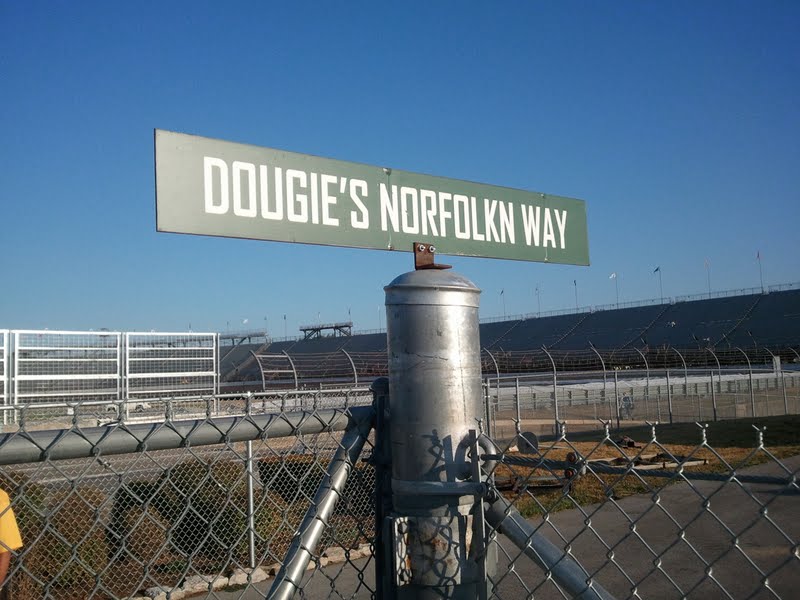
2.  People are always ragging on the yellow shirts at IMS.  They yell, blow whistles, and generally brook no argument.  When alcohol induced stupidity by the fans is not involved, I have found the majority of these men and women to be friendly and helpful.  The rest, of course, are petty tyrants and martinets.  Do the workers at IMS really have a sense of humor?  Check out this sign I saw as I entered the track on Sunday.

Love it, right?  Good stuff.

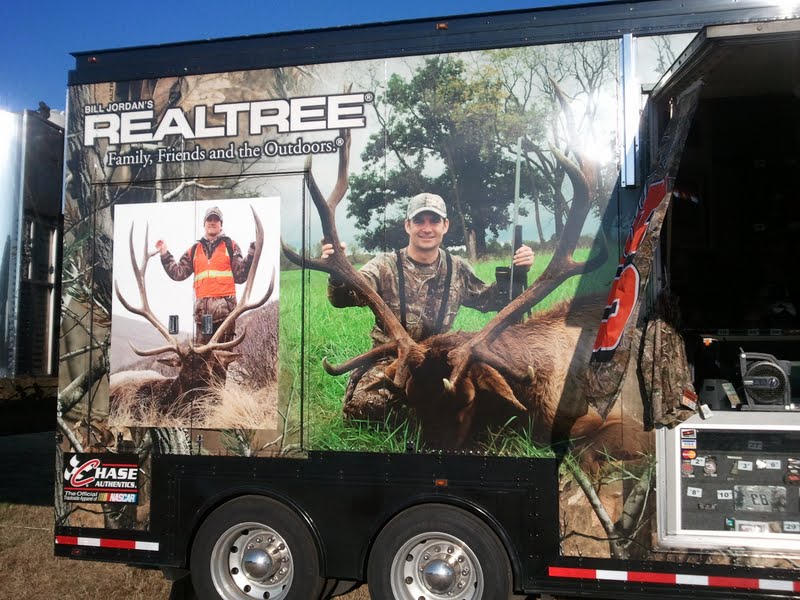
3.  I knew I wasn’t in Kansas anymore when I walked down the merchandise trailer row.  I counted over 30 trailers hawking hats, shirts, baby apparel, models, scanners, and various and sundry cheaply made and overpriced items that a person does not need.  EVERY name driver has a trailer.  IndyCar cannot compete.  I continued my tour and came to a trailer that had a giant picture of Jeff Gordon wearing camouflage posing with what appears to be a large, dead elk.

This trailer was selling nothing but camouflaged team and driver gear.  I have never seen this merchandise at an IndyCar race.  I think we are appealing to a different demographic.  Of course I now have a Tony Stewart camouflage hat to wear golfing.  Stylish.  When in Rome…

4.  The Continental Tire Series, with its production based cars and “gentlemen drivers,” and the Rolex Series both put on damn good shows on Friday.  They run in the rain!  I consider myself an Indy guy, but I have no problem with Indy hosting other series.  It’s their track and their business.  Make some money so the IndyCar series stays strong.  Keep these races.

5.  The Indy 500 has its share of drinkers, tattoos, mullets, and boorish behavior, but I’m pretty sure the per capita on these belongs to NASCAR.  I’d bet the 500 leads in total arrests, but I’ll have to go the over on NASCAR with concealed weapons.  It’s a different crowd.  A strong need to root against someone seems to exist in stock car racing.  You not only rabidly pull for someone, you just as rabidly pull against an opponent you perceive to have done your driver wrong.  I’m convinced you could get shanked in the lavatory for wearing a Juan Pablo Montoya shirt if he had just wrecked Junior.  Or maybe just for wearing a Juan Pablo Montoya shirt.  And I’m just talking about the women’s lavatory.  It’s a rough crowd, particularly for my refined tastes.

6.  How about that race?  Be honest with me.  You took a nap, didn’t you?  In a race to race comparison, the Indy 500 laps the Brickyard 400.  Indy had lead changes, charges through the pack, and a last lap dive bomb in Turn One that THRILLED the crowd.  I get it that NASCAR has more pit strategy with 2 or 4 tires and all the adjustments you can make during a race.  In my opinion, it’s a product of a relatively low-tech series that is just coming to grips with its “shade tree mechanic” past.  Still figuring that fuel injection out, huh?

7.  Give credit where credit is due, though.  The traveling carnival that is NASCAR dwarfs the IndyCar show.  NASCAR is BIG.  They have a mass of haulers just for the series gear.  The downside to that is NASCAR has a very high overhead as a series in a very bad economy.  IndyCar’s more streamlined product may be in better shape to weather the economic storm.  IndyCar is lean.  NASCAR  has to feed the bulldog EVERY week.

8.  Traffic in the Brickyard 400 Social Media Garage was much stronger than the Indy 500 traffic.  Even though the room was hidden this week, a good number of NASCAR fans came in to check it out.  This second iteration of the SMG was also better suited to move people from entrance to exit.  Also, the Brickyard 400 brings the local Indy 500 fans.  It was good to see so many of my social media friends, especially those that had Fuzzy’s Premium in a chilled flask.  Cheers, friends.  I was hoping people were stopping in to see me, but I have a suspicion the air conditioning was the main attraction.

9.  One of the highlights of the Social Media Garage was when Chevrolet brought Jimmie Johnson, Jeff Gordon, and Tony Stewart in for special wristband interviews.  Doug Boles, VP of Communications conducted a very professional Q and A.  The drivers were relaxed, engaged, and funny.  When I asked Gordon if he ever wanted to get back in the sprints and midgets, he said he gets the itch every time he sees a race, and he plans to attend the Knoxville Nationals this year.  Loved that answer. When Tony Stewart was asked what he does when it rains, he said, “I try to get somewhere out of the rain.”  He said it with a smile.  When I asked him what car or formula had the steepest learning curve, he said the winged sprint cars he’s racing now are the hardest to learn because the left side digs in going through the corner, not the right like the non-wings.  The guy is a flat racer.  Johnson talked about moving from bikes to buggies to stock cars.  Basically, he has been in a stock car since his teens.  It’s all he knows.  All three love Indy, and it shows.

10.  NASCAR drivers are rock stars.  They can’t walk anywhere without a crowd forming.  One thing I like about the 500 is that the fans respect the drivers as they walk from place to place.  If they stop, then of course the fans will ask for autographs, but it’s not a free-for-all with drivers ducking for cover.  I like the more mature reaction of the IndyCar fans.

Let me just give credit where credit is due.  Cassie Conklin is the IMS person in charge of new media.  The social media people who come in (like me) are pains in the neck.  Cassie’s a saint.  Pippa Mann stopped in and was her usual friendly and professional self.  What an ambassador for IndyCar.  Jarrett Peyton, the son of Walter Payton, stopped in with his amazingly positive personality to just hang out and talk.  Ashley Stremme, wife of NASCAR driver David Stremme, stopped by to chat with Jessica Northey and stayed to talk racing.  She grew up in a racing family and drove dirt modifieds.  She had interesting comments on being a one car team struggling to find sponsorship.  I’m now a fan.  Last, but not least, Todd and Cary Bettenhausen, the twin sons of Gary Bettenhausen, were in all three days helping visitors to the SMG experience iRacing.  Every kid that needed it got positive and friendly instruction.  And the boys had some racing stories to tell.  IMS history was right there next to me.  My opinions may be worthless, but the experiences I’ve had this year through IMS, Twitter, and this blog have been far from that.  Sometimes that stranger mentioned in the title finds a home.

Ten Worthless Opinions – (Sponsor Name Here) Edmonton Indy Edition

After such a great race in Edmonton, Alberta, it was discouraging to hear talk of the race not coming back due to sponsorship difficulties.  The talk seems to center around local engagement and activation.  Nothing a title sponsor can’t solve.  What does it take to get the folks from Medicine Hat, Okotoks, Wetaskiwin, Athabasca, Waskastenau, Atikameg, Ponoka, and Sexsmith to fully engage?  OK, judging by the name, maybe the folks at Sexsmith are busy with other activities.  This was a fantastic race.  C’mon, local Canadian populace, you can’t just fish and drink beer all summer.  With the oil business at the center of Edmonton commerce, you would think local connections would flourish.  That’s why this week’s title is (Sponsor Name Here) Edmonton Indy Edition.  I’m willing to do my small part to help recruit sponsorship.  Here are this week’s WO’s (worthless opinions).

1.  I thought I would familiarize myself with Edmonton by taking out my atlas and HOLY SMOKES, EDMONTON IS IN THE MIDDLE OF NOWHERE!  I grew up in a small Indiana town (Shirley) and thought it was the middle of nowhere, but now I know how wrong I was.  I can only assume the winters at this northern latitude are brutal, and the summers are plagued by giant biting flies.  Am I wrong?  I can see why a title sponsor is difficult to find.  Bad economy, wrong location (notice I did not say “bad location”), and low TV ratings may doom this race.  And that’s too bad; the racing was excellent.  Speaking of races, Randy Bernard is still adamant on 19 races while reports suggest that some owners are happy where they are and don’t have the money to expand to 19.  Sometimes I just shake my head at the dysfunction in the IndyCar family.  I think they all need therapy.  As a fan, I know I do.

2.  The teams complained about the long drive.  What’s the payoff for them?  Are they going to excite their sponsors with hospitality in Edmonton?  Sadly, there is no compelling reason for owners, teams, and sponsors to go to Alberta, Canada.  The Calgary Stampede does draw a huge crowd, though.  Hmm.  Maybe Randy Bernard can use his rodeo connections to combine the Stampede and the (Sponsor Name Here) Edmonton Indy race.  I’m an idea guy.  Just one of the many services offered here at New Track Record.

3.  Is it my imagination, or is NBC Sports tweaking the pre-race a little?  The giant gear that serves as Kevin Lee’s pre-race perch was missing.  That was probably a cost containment move, though.  Again, the costs to go to Edmonton are enormous, and does NBC Sports really need that piece of modern art and the wranglers that go with it?  It will be interesting to see if it continues to show up at other races.  NBC Sports cutting an already low-budget presentation is not good news.

4.  Robin Miller has been marginalized as an in-race reporter.  His schtick is the grid run.  He even has his own cartoon graphic now.  He’s NBC Sports version of Fox Sports’ Digger.  Here’s my idea.  Create a college-type mascot of Robin Miller.  He can parade up and down pit row in his suit with the Firehawk.  They can even play little tricks on each other.  With the quality of the questions he’s asking in the grid run now, the mascots vow of silence can only be a benefit to the viewer.

5.  What’s up with Marty Snider?  He went from a pretty good pit reporter to a shit-stirrer.  Pre-race, he tried to get Sebastien Bourdais to comment on Charlie Kimball from last week, even asking if an apology was offered.  Post-race, he tried to get Ryan Hunter-Reay and Will Power in a dust-up about Power’s alleged chopping of RHR while exiting the pits.  He also tried to get Helio Castoneves to comment on last year’s penalty.  It seemed contrived.  Is some faceless producer trying to spice things up?  Is NBC Sports trying to create some soap opera controversy?  I can’t blame NBC for trying to start things.  Ratings rule.  Let’s see if this continues.

6.  It was nice to hear Simon Pagenaud tell us that his run-in with Josef Newgarden at Toronto was not really blocking.  It was just two moves (his and Newgarden’s) at almost the same time.  I’m reminded of the guy caught in the act asking his wife, “What are you going to believe, me or your own eyes?”  I’ll stick with my own eyes, but thanks for asking, Simon.

7.  Push-to-pass, or PTP, seemed to work well.  NBC Sports showed a graphic that let the viewer know when PTP was in use and how many seconds were left.  It had my interest in the last few laps as Takuma Sato tried to overtake Helio Castroneves.  In other words, it engaged me.  Keep it.

8.  I did notice that IZOD used two different commercials, one with golfer Kevin Na and one with their normal set of models splashing fully clothed in the ocean.  Still no commercials using or connecting to IndyCar.  So long, IZOD.  It’s been good to know you.  I’ll miss buying your socks and pocketed T-shirts.  They have become my signatures.  And the Van Heusen commercials with Jerry Rice and Steve Young will also be gone since Van Heusen owns IZOD.  But before you go, can you do one commercial where Robin Miller is the “schlub.”   Please.

9.  I loved all the passing at the (Sponsor Name Here) Edmonton Indy and how NBC Sports continues to show the passes, both live and on replay.  This is how you keep your core fans engaged.  Show them racing.  Let Marty Snider titillate the casual fans with  gossip; show me the action.  And I agree NBC needs both because they need the viewers.  Whatever works.

10.  I love the IndyCar post-race interviews.  The NASCAR drivers are often surly and pissy.  The IndyCar drivers seem approachable and willing to sell the brand, both their own and the series.  Helio Castroneves bubbles over with emotion.  How can you not like him?  Alex Tagliani was gracious in defeat.  Takuma Sato was all smiles.  OK, Ryan Hunter-Reay was a little moody now that he expects to win every race, but I’ll give him a pass this time.

There you go.  I hope you found this week’s WO’s (worthless opinions) satisfying.  Hopefully, IndyCar finds itself back in Edmonton, Alberta next year with a title sponsor and plenty of insect repellent to keep those damn biting flies off.  In honor of our northern friends, I leave you with this famous paean to western Canada.  You’re welcome.

The survival of ovals in IndyCar

As a fan of IndyCar racing, I like all the venues to some degree or another, but I love the ovals.  I grew up on the Indianapolis Motor Speedway and the Saturday and Sunday night stock car races at my local paved ovals of Sun Valley Speedway (now Anderson Speedway) in Anderson, Indiana and Mt. Lawn Speedway near New Castle, Indiana.  Just like you become a fan of a baseball or football team due to its proximity to you, I became a fan of oval racing because it’s what I saw on a regular basis.  If the midgets or sprints were there for a show, it was true exotica.  The Indy 500 was the pinnacle of the auto racing world.  I make no apologies for holding open wheel oval racing in such high regard.  Friends have tried to explain the nuances of road and street racing to me in the hope I will love it like they do, but I keep coming back to the speed, intensity, and danger of the oval track.  As I watch the slow withering of my favorite form of auto racing, I am buoyed by the success of Iowa Speedway.  They have figured out how to make oval racing successful.

Iowa Speedway has become a favorite oval of mine.  The cars are fast and the track is tricky.  The new aero package has them lifting in the corners.  The tires go away making the teams choose to be fast early in the run or save the tires to be fast later in the run.  Setting up a pass may take two or three laps, but passes can be made.  The cars actually need to be driven.  A team needs a strategy to be successful.  And Iowa had on-track action throughout the weekend.  No longer can IndyCar just run one race.  At Iowa we had three IndyCar heat races, a midget race, a Silver Crown race, a Star Mazda race, an Indy Lights race, and the IndyCar feature.  By my count that’s eight races.  Plus, the Indycar practice sessions set the fields for the heat races.  Take note, promoters: put action on the track.  That’s called VALUE.

But a successful race needs more than good racing.  It needs a promoter that knows how to sell and fans that come to the race.  With all of our eyes glued to the success of the series and the TV ratings, we forget that the promoter must make money – money that comes from either the paying customer through ticket, concession, and merchandise sales or from the promoters ability to sell sponsorships and partnerships with businesses.  Oval track promoters should take note of how Iowa Speedway does business.

Andretti Sports Marketing did a masterful job of creating interest and value for the Milwaukee race.  They created value by adding racing events, a midway, and lowering ticket prices.  People in the seats create a profit.  What they don’t have is a title sponsor paying them money.  And that is where Iowa Speedway excels.  Iowa Speedway succeeds because it attracts sponsorship and sells tickets.  Period.  How does this small track with about 30,000 seats manage to survive?  The simple answer is they find local sponsors who want to connect to local customers.

Take a look at the sponsors for the IndyCar, Nationwide, and Camping World truck weekends:

  •  Casey’s General Store USAC Challenge Presented by Messerschmidt Ice and Kix 101 (USAC Midgets and Silver Crown)
  •  Sukup 100 (Firestone Indy Lights)
  •  Iowa Corn 250 (IndyCar)
  •  American Ethanol 200 (TWICE!  Once in July and once in August for the trucks)
  •  Prairie Meadows 200 (ARCA)
  •  U.S. Cellular 250 Presented By the Enlist Weed Control System (Nationwide)
  •  Pizza Ranch Winner’s Circle

Notice anything in the list?  Other than the U.S. Cellular 250 Presented By the Enlist Weed Control System, every other race is sponsored by an Iowa business (U.S. Cellular is Illinois based and Enlist is weed control for corn marketed by Indianapolis based Dow AgroSciences.)   And guess with whom Iowa businesses want to connect?  Yep, those convenience store shopping, grain bin storing, corn growing, cell phone using, weed killing, ethanol producing, pizza eating Iowa farmers.  And connect they do.  The track was packed and the hospitality tents were full.  These local sponsors reaching out to local consumers were activated at Iowa Speedway.  Are the sponsors happy?  I asked Mindy Williamson, the communications and PR director for the Iowa Corn Growers Association, a few questions about their sponsorship of the Iowa Corn 250:

NTR: What is the value of this sponsorship to your organization?

Williamson: We have an excellent return on investment. We have the opportunity to talk with those outside of agriculture about things like ethanol, but also what corn means to our state and the many products we produce. We also have an opportunity to thank our members and give farmers a chance to enjoy themselves as VIP’s in our hospitality tent. We have each year about 1500-2500 farmers and their families that join us for the fun!

NTR: How do you activate at the track?

Williamson: We activate on many levels from advertising, to working with drivers, to promoting ticket sales, to on track involvement. We use traditional media, social media, member communications and more to reach people with our messages. I hope you saw and heard messages from Iowa Corn while you were here!

NTR: What response do you receive from your members?

Williamson: They love racing. In fact, racing is the number one sport among farmers. Some of them are new to IndyCar racing, but they are interested in the mechanics, the technology, and the innovation – many of the same things they invest in on their farms.

Clearly, the Iowa Corn Growers, the sponsor of the Iowa Corn 250, see value in this event.  I would expect the sponsors of the other events at Iowa Speedway see similar value to their sponsorships.  What lesson can be learned from Iowa Speedway?  It’s simple.  Ovals can thrive when the promoters seek out sponsorship that connects to the people who will be sitting in the stands. In Iowa, that demographic had a connection to agriculture.   Milwaukee, Phoenix, and Pocono, for example, would be attracting a different demographic.  But Iowa has a secret weapon.  It is not owned by ISC or SMI.  It is not a pawn in the battle between all the competing motorsport series.  Iowa Speedway is like the small oval tracks of my youth.  Its success or failure is its own.

The sad part of this story is that the locally owned and operated oval that works hard to make each event a success has been replaced by the corporate gamesmanship of both ISC (International Speedway Corporation) and SMI (Speedway Motorsports, Inc.), the owners of most major speedways in America who use their tracks like pawns in a large chess game to deny access to IndyCar or to devalue the series for the betterment of the NASCAR series events they prefer.  The Iowa Speedway model works for ovals.  The problem is there are so few independent ovals to use the model.  So unless IndyCar decides to get in the track-owning business by buying the ovals in Nashville and St. Louis, they had better take real good care of the people who are taking good care of them, or the oval racing that is IndyCar’s past will be relegated to the history books.  And any promoter that wants a model for oval success should give Iowa a call.  They get it.

All right, Mr. Bernard, I’m ready for my close-up

I’ve always been a fan of the cinema called film noir [1]: hard-boiled detectives, dark alleys, shadows, grit.  It’s not the place you expect a happy ending.  A high water mark of the genre is Sunset Boulevard [2] with Gloria Swanson as the delusional Norma Desmond and William Holden as the ill-fated hack writer Joe Gillis.  Once again, life imitates art as IndyCar intersects with the characters of Sunset Boulevard.

At one time, Norma Desmond had the adoration of millions, the mansion on Sunset, money in the bank, a classic limousine, a pet chimpanzee, and her butler Max.  The connections to IndyCar are clear: Norma is IndyCar.  At one time, her star shone brightly.  She was adored by millions, and the money rolled in.  It was the same for the previous incarnations of IndyCar.  Its place in the pantheon of sports was unrivaled.  The names of the drivers were known by millions, and the mansion at 16th and Georgetown was nonpareil.  The cars at the mansion were classic.  The media and the fans fawned on Indy’s every action; Indy car racing was worshipped and admired,  just like Norma Desmond.

But the good times don’t last, do they?  In the movie, Norma Desmond, a silent film star, was left behind when sound came to the movies.  She never came to grips with the fact that she was no longer a star.  Poor IndyCar has suffered the same fate.  Both Norma and Indy car are rich, but their popularity has waned.  People just don’t seem to care as much.  But Norma, losing her grip on reality, didn’t get it.  She still thought she was a star.  Similarly, Indy car was a star until the CART/IRL split.  And just like the talkies left Norma behind, the split left Indy car racing out of the eye of an ever fickle public.  Norma never accepted her fate, nor did Indy car racing.  Both continued to wait for the elusive starring role to appear.  IndyCar is still waiting.  Norma says: “I am big.  It’s the pictures that got small.”  Change a word or two, and you have IndyCar’s philosophy during the split.

And how about the character of Joe Gillis.  Joe was seduced by the money of Norma.  He had nothing, so he had nothing to lose.  In many ways, you can say the hard-core fans and the media are Joe.  His self deprecating comments and subtle snark toward Norma highlight the dark comedy of the movie.  IndyCar has had its dark comedic moments recently: a wrong way truck at Baltimore, a rainy restart at New Hampshire, and poorly managed races at more than one venue top the list.  The media and the fans, witnessing the the delusional behavior of a race control that continued to act as if nothing was wrong, rightly pointed out that the belief that all was well with IndyCar racing was a fantasy.  Joe Gillis voiced his comments softly since he did not want to upset the Norma Desmond gravy train.  IndyCar’s media and fans were much more vocal and much less subtle.

This all leads us to the final scene.  Joe has decided to leave the increasingly erratic Norma, who believes Cecil B. DeMille wants to produce a script she has written.  She shoots Joe as he is leaving.  Norma is completely disconnected from reality now, and her butler Max, played by Eric Von Stroheim, coaxes her downstairs to the police, reporters, and cameras by pretending she is in a movie. To get her downstairs, he calls “Action.”   Norma looks at the cameras and utters her famous line: “All right, Mr. DeMille, I’m ready for my close-up.”

Maybe I’m the one that’s delusional.  Maybe I’m the only one that sees the connection.  Randy Bernard is Cecil B. DeMille.  He is the producer who is going to create the next big movie.  The problem is he doesn’t want to have an aging, delusional IndyCar as his star.  He needs something new, and he has it.  The series has a new car, new engines, new teams, new drivers, new race director, and hopefully a new direction.  As IndyCar descends the stairs for a new season, you know what is going to be said: “All right, Mr. Bernard, I’m ready for my close-up.”  Let’s hope it’s a blockbuster.  Lights.  Camera.  Action!

1.  Just a little background on film noir (nwa) in case you want to know. http://en.wikipedia.org/wiki/Film_noir

2.  Here’s the story of Sunset Boulevard.  http://en.wikipedia.org/wiki/Sunset_Boulevard_%28film%29

What does NASCAR have that IndyCar doesn’t?

I don’t hate NASCAR.  I just hate some things about it.  Allow me to make a list:

  • Digger
  • DW
  • “Boogity, boogity, boogity”
  • That NASCAR claims it invented safety (SAFER Barriers, safety teams, Band-Aids)
  • Its owners heavy-handed attempt to control all tracks in America
  • Its owners more subtle attempts to marginalize IndyCar racing
  • That NASCAR is broadcast on multiple networks
  • That ESPN owns broadcast rights and acts like it’s reporting on an event when in reality it’s promoting its product
  • That hillbilly jackanapes now look down their noses at IndyCar because of the popularity of their series (my apologies to hillbilly jackanapes everywhere)
  • THAT NASCAR IS MORE POPULAR THAN INDYCAR, AND YES, I KNOW THAT SOUNDS LIKE SOUR GRAPES AND JEALOUSY BECAUSE IT IS!

Whew.  I’m glad I got that out of my system.  My jealousy overflowed this past weekend as I watched NASCAR testing broadcast on Speed.  And it was fully sponsored.  TESTING!  *Excuse me a moment while I take my medicine… Back now…Blood pressure under control.*  TESTING!  ON TV!  WITH SPONSORSHIP!  How did this happen?  When did America jump the shark?  Is the current administration in DC responsible?  Is it the economy?  Does it have something to do with the residual effect of concussions from football?  I NEED ANSWERS!

Now, I do understand a few things.  I know the networks heavily promote NASCAR.  IndyCar is lucky to be mentioned unless there’s tragedy or comedy.  Purported news organizations like ESPN are just shills for their own products, and I hate the inherent dishonesty of that.  There should be a disclaimer.  I understand that IndyCar is locked into the Versus/NBC Sports contract, but what’s the future of that?  Will NBC cross-promote the series?  Will IndyCar become a network star or a cast-off?

What does NASCAR have that IndyCar doesn’t?  We have strong teams, drivers who can run multiple circuits, a new car, compelling story lines, and momentum.  What do THEY have?  They have fans who provide ratings.  And ratings that attract sponsors.  And sponsors who provide money.  And money that supports the teams.  And teams that go racing.  And racing that attracts fans.  And we start the circle again.

We all know what NASCAR really has.  They have the eyeballs that watch TV.  That’s it.  The racing is no better than IndyCar.  NASCAR was just another racing series until ESPN decided to make them a big deal.  And they did.  IndyCar’s best hope is to get what NASCAR has: a network sugar daddy.  Our long-term survival as a series is uncertain, and NBC Sports/Versus is our hope and our future.  We only hope that they need us as much as we need them.

If all else fails, we can go the NASCAR route and tell lies and half-truths about our competition with a snide superiority.  Audacter calumniare; semper aliquid haeret.  Slander boldly; something always sticks.  Oh, did you hear that the France family is going to sell NASCAR after the Daytona 500 because of financial issues?

All the pretty hypocrites

The origin of the word hypocrite goes back to the Greek word hypokrites, a stage actor; one who pretends to be what he is not.  And racing is full of these actors, these hypocrites who mouth platitudes and wring their hands over the plight of IndyCar.  These people who know best (and there are always people who know best) are ready and willing to solve all of IndyCar’s problems, real or perceived.

After the multi-car crash at Las Vegas, the hue and cry to end pack racing rose from everywhere: the media, the fans, and the drivers.  The only voices that ring true are the ones of the drivers.  There is an old adage about a ham and egg breakfast: the chicken is involved, but the pig is committed.  The drivers are committed.  Their opinions are truly the ones that matter.  And we can assume they do not prefer the high-banked 1.5 mile ovals in the current low-horsepower, high-downforce configuration.  But they race them because that’s where the race is on a particular weekend.  They do this most dangerous of jobs for one simple reason: it’s the job they love to do.

Are the fans hypocrites?  Do we expect the drivers to accept an unreasonable level of danger simply because we enjoy the spectacle and the risk?  The answer to both questions is absolutely.  And how often have you heard this justified with a comment along the lines of “The drivers understand the risk” or “If they don’t want to race there, then they can find another job.”  And if not these quotes, then variations on the theme.  Of course the fans are hypocrites.  Most of us would never strap into a race a car a first time, or a second time if we did it a first time.  If our jobs were unduly dangerous, we would be howling to any government agency or union that would listen.  We really don’t have a horse in this particular race.  The drivers should have some input in where and how they race.  And remember, I am an ovalista.  I want IndyCar to find a way to make it fun, fast, and safer on the small ovals. The question for the ones who do know best is how to do it.  And the fans are not the ones who know best.  In this case, the customer might be wrong.

And how about the media?  Don’t get me wrong, the majority of IndyCar media gets it right.  Of course there are not too many of them left.  And that’s a problem.  Marshall Pruett is a steely-eyed missile man.  He researches, he reports, he informs.  And Curt Cavin from the Indy Star is a daily source of info in his blog.  He’s wired in.  He may be the last of a dying breed: an assigned reporter for IndyCar coverage on a daily newspaper.  What can I say about Robin Miller?  IndyCar coverage would miss his passion, knowledge, and even his opinions if he wasn’t around.  Of course, we have “Miller’s Mailbag” and his Greek chorus of Chicken Littles on Speedtv.com, but I read it religiously.  People may disagree with his negativity, but he has both an opinion and a platform.  Can you name another major national publication with a dedicated IndyCar section on its website?  We ought to be happy that someone still cares.  What about Versus and ABC?  Again, I’m happy to have any coverage, but let’s face it, the TV reporters, no matter how good or bad, are just shills.  Their raison d’etre is to attract viewers and increase ratings.

But the media members and outlets that gall me are the ones that deign to pontificate after the fact.  They jump on auto racing with both feet and condemn the series, the tracks, and the fans for being part of a brutal and deadly sport.  Do these same reporters condemn NASCAR for pack racing at Daytona and Talledega?  Do these same TV networks use the possibility of the “Big One” as a lead in?  And I hold a particular distaste for the reporters who do not follow IndyCar in particular or racing in general but use a tragedy like Las Vegas as a platform to get their names attached to a national story by vilifying a series, a promoter, and a track.  Hypocrites all.

The public has a very short memory.  History has shown us this same picture before at Indy: the1958 first lap multi-car accident in Turn Three that took the life of Pat O’Connor, the 1966 first lap multi-car accident, the 1973 first lap accident that sent Salt Walther spinning and spewed fuel into the stands, and the 1982 first lap accident with Kevin Cogan, Mario Andretti, and AJ Foyt.  And we know there will be another.  We know that we cannot legislate complete safety into the sport.  We close our eyes to the fact that IndyCar has not seen its last multi-car accident or its last fatality.  This dark knowledge sits deep inside us as we defend this sport we love.  And that may be the most hypocritical of all.

Post Navigation