New Track Record

IndyCar Blog

Archive for the category “Humor”

The good, the bad, and the ugly of the 2014 Indianapolis 500: Part II – the bad

It always comes down to this.  For every yin, there’s a yang; for every oversteer, there’s an understeer; for every drunken race fan there’s a smug glare of self-righteousness.  Part I of this series was the “good” of the title; the events, people, and actions that make Indy what it is.  For the sake of fairness and snark, there must be a “bad.”  Presented here are the ones that made the cut.

Bad

1.  The bad on the track was easy.  The contretemps among Ed Carpenter, James Hinchcliffe, and Townsend Bell took out two cars that had a chance to win with Bell wrecking later with what may have been problems stemming from this incident.  It was nice to see the bad side of Ed Carpenter, though.  His dirt track days just jumped out of him.  Not only did he physically loom over Hinchcliffe while Hinch was sitting in his car, he was quoted on ABC saying that it’s lucky Hinch had a concussion two weeks ago.  The indication being, I think, that if Hinch wasn’t already concussed then Ed would have been more than happy to oblige.  Dirt track meets championship wrestling with Ed Carpenter flipping from face to heel.  Bad boys.  Hinchcliffe did accept the blame, though.  Stand up guy.  Of course when video shows clearly that you made it three wide, there’s not much else to say.

2.  The luck of Chip Gaanassi racing was most definitely bad at Indy this year.  Not only did the boys have trouble qualifying, but Scott Dixon, Tony Kanaan, Charlie Kimball, and Ryan Briscoe placed 29th, 26th, 31st, and 24th respectively.  Ouch.  Now that’s a “Bad Moon Rising.”  It’s time for someone there to say “Got my Mojo Working.”  Just a couple of Creedence Clearwater Revival and Muddy Waters references for you.  Again, it’s all about racing and popular culture here.

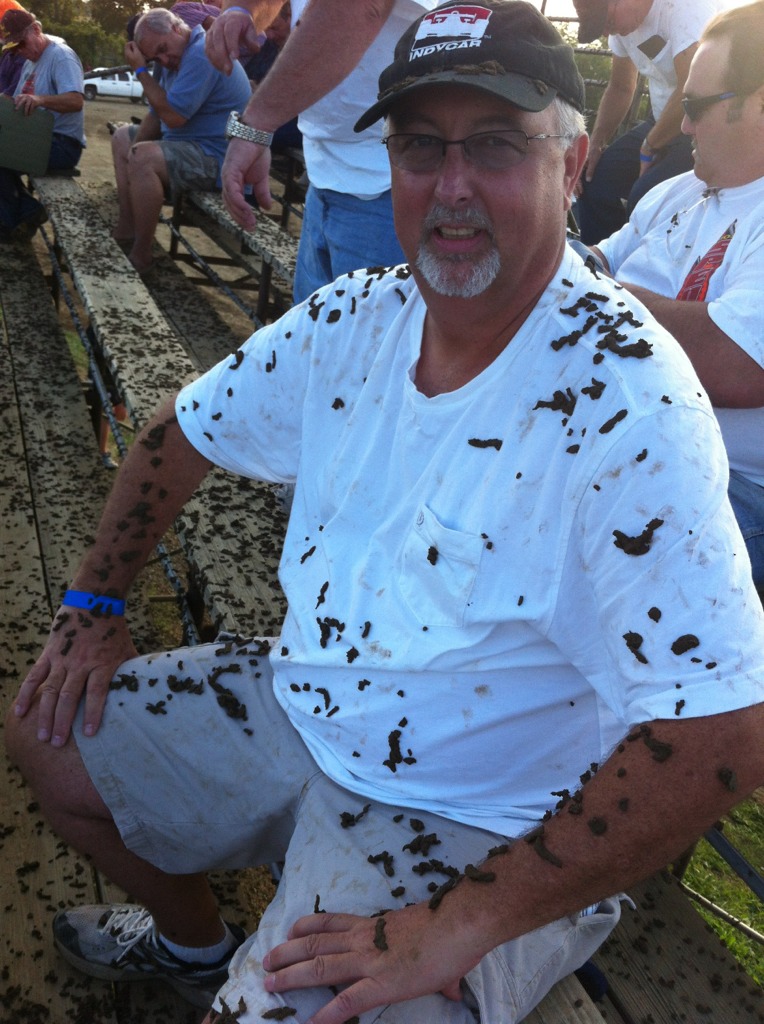
3.  As someone who paid $75 to IMS for parking passes to the North 40 (Lot 7), I was more than a little miffed when the parking attendants told me at 7:30 AM that there were no spots available for me to park.  My explanation that having a reserved spot to park is precisely the reason that IMS sold the parking passes and why I decided to buy them left the dead-eyed, yellow shirted parking attendant unmoved, and I was forced to park at the back of the North 40.  Imagine my surprise when I checked the front of the lot where I was supposed to park and found almost no cars with parking credentials.  It was just a smaller version of last year’s line fiasco being played out on a grassy stage.  Normally, commerce is conducted in such as way as to give a guest or client what they paid to get.  When you pay a year in advance for something you don’t get, it’s called chiseling. To put it another way, imagine how you would feel if you stood in an enormous line behind the NE Vista to purchase a $9 tenderloin and were told AFTER you paid for it, that it was given to an earlier patron for free.  “Thank you, and please come again.”  Bad business, that.

4.  Let’s talk about those bad concession lines.  In the NE Vista, which was packed, the new food service professionals at Levy Restaurants decided it was better to have fewer open concession stands to serve more people.  The lines were endless and slow.  I’m just glad IMS contracted the food service out to those that do it for a living.  I’m sure there’s an explanation for how this is better for the guests on site.  Spin it!

5.  With the last “bad” in mind, let’s consider that the marks customers are now paying more for every item on the concession list.  Again, I’m just a plebeian, untutored in the art of separating acquiring money from rubes guests.  I am sure a computer wonk in accounting can show how much better all this is for IMS.  And that is what counts.  I am sorry for being so selfish here and thinking only of my experience.  Mea culpa.

6.  I am sure I am no the only one who has noticed the decline in the interest, enthusiasm, and competence of the fabled Yellow Shirts at IMS.  Even though I have called some “petty tyrants and martinets,” it was obvious that they took their jobs seriously.  Many of the workers now seem unhappy and disinterested in improving the guest experience. For all the world, it seems like most have little or no training.  Many out in the hinterlands of the facility seem to have the dead, vacant stares of those who have the seen the world at its worst: fast food workers.  It’s not pretty.

7.  Finally, what saddens me the most is the passing of an era, the loss of innocence.  IMS has finally gone over to the dark side of corporate America.  No longer do I have the sense that the series, the race, and the facility are some Mom and Pop organization run on whims and greyhound rescues.  No, it has become the antithesis of that. It is now a business run on the American virtues of greed and profit.  And I’m really okay with that.  Money is good for the drivers, the owners, the promoters, the tracks and the networks.  It’s just not good for the soul.  I miss my old friend, the one who let you get falling down drunk on reasonably priced beer, the one who sold you a greasy frozen fritter of pork without acting like it wouldn’t give you heartburn, the one who allowed you to torch couches and old cars in the infield for the sheer joy of socially accepted arson.  Today, Simon and Garfunkel would sing, “Where have you gone, Indianapolis Motor Speedway? Our nation turns its bloodshot eyes to you.”  Woo, woo, woo, indeed.

Don’t get me wrong, the good far outweighs the bad in regards to my race day experience.  The Verizon IndyCar Series still offers the best racing on the planet.  I’ll be coming back with more cash in my wallet and lower expectations of what that cash will buy me but higher expectations for the action on the track.  And that is really the bottom line.


The good, the bad, and the ugly of the 2014 Indianapolis 500: Part I – the good

The new month of May at the Indianapolis Motor Speedway is behind us, and as the sunburn, hangovers, tenderloins, and poor choices recede into our memories, it is best that we all reflect on the events before they fade away completely.  So as not to break any new ground with creative thought, I would like to look at recent events through the conceit of the Clint Eastwood movie The Good, the Bad, and the Ugly.  This three part series will look at one aspect each day.  Today, we look at the good.

The Good

1.  Ryan Hunter-Reay is absolutely going to be a good Indy 500 champion.  I have always been rather lukewarm towards RHR.  He seems to say the right things and avoids controversy.  Fair enough.  His two passes of Helio Castroneves for the lead in the closing laps of the 500 were gutsy and aggressive and belied his rather vanilla persona.  When Castroneves throws his samba blocking moves on, he’s more than tough to get around.  Hunter-Reay’s quotes in Victory Lane showed an emotion previously kept hidden and that, along with his refreshing honesty, resonated with me.  He truly gets the 500.

2.  Hunter-Reay said in his post race interview that he was “a happy American boy.”  Although it may seem jingoistic, an American winning the 500 is important to a series that currently runs all but one race on American soil.  The lifeblood of the Verizon IndyCar Series is the red, white, and blue flag waving fans that were in abundance on Memorial Day in Indianapolis.  We can only hope that the series is able to capitalize on this American winner of the 500 more than they did the same winner of the series in 2012.  Wait, did I snarkily offer a “bad” in here?  Sorry.  I will try to stick with the script.

3.  As expected, the racing was great.  What more do the fans want?  There were multiple passes for the lead, including those by RHR and Castroneves in the closing laps that required more than a little sand.  The cars once again protected drivers like Scott Dixon and Townsend Bell in HARD hits.  Give me safety over aesthetics any time.  Fie on the fans who decry this ugly beauty.¹  The DW12 is a great race car, no matter how it looks.  And it is ugly.

3.  The red flag at the end of the race, while unexpected and without precedent, was good for the fans in attendance and the TV audience.  As a traditionalist in general, I initially thought that one more IMS accepted protocol was going down the drain.   But after seeing the debris from Townsend Bell’s crash and watching the SAFER barrier being repaired, I realized it made the race better.  Change is sometimes good, even if it causes apoplexy in the hard-core constituency.  Who knew?

4.  The crowd was not just good at the race, it was great.  The Coke Lot was full at 7:30 AM as we arrived at the Speedway.  I have not seen that in 25 years.  Of course the downside of that is the Coke Lot was full of Coke Lot type denizens at 7:30 AM.  Estimates  of the crowd were up to 230,000.  Don’t let those empty seats fool you.  The place was full.  The lines to get into the facility that made life miserable last year were not issues.  The purchased parking credentials in the North 40/Lot 7 were another story, though.  Dang.  There I go again with the snark about one of the “bad” issues.  An official for the Speedway told me that ticket sales were up 25% this year.  Indy is back, baby.

5.  Although the commercials on ABC seemed interminable after I got a chance to watch, the pre-race portion is still the best around.  The network wove in Memorial Day, human interest, and race goodies in just the right proportion.  Watching the race in HD, particularly the in-car shots, is absolutely thrilling.  Although not “bad” by definition, I do find the constant video and interviews of the WAGS a little cloying.  Nobody ever yells “Show us the wives and girlfriends for god’s sake!” as a race winds down.  Nobody.  Ever.

6.  The pre-race ceremonies at IMS for the 500 are nonpareil.  If you have never witnessed it in person, put it on your list.  The fact of the meaning of Memorial Day is always there, as it should be.  I hope that IMS, in its quest for more profit, never turns the pre-race into a sponsored circus to make a quick buck.  It is already the gold standard.  Keep it that way.  With that said, I really will miss Jim Nabors, a B-List singer and actor who found a home in Speedway, Indiana on Memorial Day weekend.  He sang “Back Home Again” the right way.  Please IMS, don’t bring in an oddball assortment of record label sponsored train wrecks to audition.  Find another baritone who gets Indy and can make it each May for the next 30 years or so.  The name is not as important as the song.  Do NOT mess this up.

7.  The month of May is back as an event in Indy.  After years of condensing the month due to lack of fan interest, the gang in the blue glass edifice on 16th and Georgetown finally packed in enough activities to interest new fans.  The Grand Prix of Indianapolis, the new Time Trials weekend, Carb Day, the Jason Aldean concert, glamping, and the electronic dance music in the Snake Pit on race day all added fans through the turnstiles.  The numbers for the month could be pushing 350,000 fans.  Do the math.  More fans = $$$.  $$$ = more racing.  More racing = happy fans.  Repeat.

That’s the good, great, and just okay as well as some sub-textual bad that just keeps popping up.  Sorry about that.  Tomorrow brings the defined “bad” of the race.  And possibly a little more snark.

________________________________________________________________________________

¹  In my continuing effort to bring culture to racing, I used the oxymoron “ugly beauty” to describe the Dallara DW12.  An oxymoron is when two opposite terms are used together for effect.  Old Billy Shakespeare used them often when describing bear-baiting and cock fights, so there is some tradition of sporting usage.

Sitting in judgement of Indy 500 Time Trials

Suffice to say that opinions on the new qualification format at IMS for the Indianapolis 500 are mixed.  As a trained observer (I’m not), I have the opportunity to listen in on the conversations of media types, drivers, owners, and fans.  What follows is a sampling of what these different groups have to say about qualifying at Indy.  These quotes may or may not have really happened.  Go with the latter.

Old Time Local Media: “It’s a travesty.  Why, I had to park all the way over on the golf course.  I have a bad knee, a bad hip, and a bad attitude.  What would all those journalists from the 50’s and 60’s say about this parking?  I remember when the place was packed for the first day of qualifications.  Those were real drivers.  I could never really explain the old qualifying rules, but they were much better than these new ones.  Did I mention the parking.”

Modern National Media: *Crickets*

Drivers: “What the hell?  Do people know how hard it is to run flat out around this place for four laps ONE time?  Huh?  Do they?  And now they are asking us to do it on two days with chances for do-overs with no penalty.  What is wrong with these people?  This is incredibly dangerous stuff.  Wait.  Is your mic on?  Sorry.  I meant to say that the drivers are in full support of the series and IMS in their quest to bring excitement and fans back to qualifications.  A rising tide lifts all ships.”

Owners:  “We are busting our tails chasing sponsors who demand exposure and TV time.  You can believe that we support anything that helps us get this publicity for our partners.  Yes, it’s a risk for our equipment and drivers, but it’s one we are willing to take.  Anything for publicity…I mean the series.”

Hard-core Fans:  “Qualifications are ruined.  The split changed everything.  We are the only ones who really care about the history of the race and IMS.  Tony Hulman, Wilbur Shaw, and Carl Fisher would roll over in their graves if they knew what was happening.  The esoteric nature of the old qualifying rules is what separated the casual fan from the real fans.  A real fan is willing to work to understand the format.  The only redeeming feature of the new rules is that they are even more confusing than the old rules.  THAT we like since you really have to care about IndyCar to bother learning them.”

Casual Fans: “What new qualifying rules?  The fastest car is on the pole, right?  I have Twitter, Facebook, and the IndyCar 14 app on my phone.  Who needs to know about rules?  I can stream the qualifying and DVR what is not streamed.  Why does anybody care about what the rules are?  We just want to see the cars go fast.  Aren’t Hardwell and NERVO going to be in the Snake Pit this year?  The cars sure look pretty when they go by.  I liked the balloons.”

There you have it.  That’s the real skinny on what people are saying about the new qualifying format.  You can find the truth anywhere.  Always remember that this is your source for lies and innuendo.


The inaugural Grand Prix of Indianapolis: IMS gets it right…and wrong

The sports public, for whatever reason, not only wants perfection but refuses to accept those events and individuals who fall short.  Yep, we are a demanding and fickle lot.  We will forgive frailty in a person, but we do not forgive the same things with a corporation or governing body.  Recently, our Supreme Court has ruled that corporations are people, so if it were up to them, we would likely be compelled to extend our forgiveness to the likes of IMS and IndyCar for the shortcomings of the inaugural Grand Prix of Indianapolis at the Indianapolis Motor Speedway.  So in a sense of fair play, let’s take a look at both the good and the bad of what transpired at IMS this past weekend.

RIGHT

  • Starting off the month of May with an event created a buzz around the facility, the city, and the racing community.  That’s a little better than a practice day at the track where teams might do a shake-down run or two.  Traditionalists complain that this changes everything.  My response is yes, it does.  And it was well past time to do so.  The action for the month of May had become ponderous.  The tradition of oval racing only does not entertain the public.  Action does.
  • The marketing staff at IMS pushed very hard locally to promote the $25 general admission ticket with 12 and under kids free.  Great idea!  Imagine a sporting event that welcomes families.  Hook them now; keep them forever.  Maybe they upgrade to the grandstands in the future.
  • The upgraded spectator mounds provided excellent sight lines with up-close viewing.  I had a chance to check out all the mounds on Friday.  The Turn 1 mound provided a good look at the cars heading for the braking zone into Turn 1 at the start of the race, but of course that was a null point.  The best view at the north end of the track was the Turn 2, 3, 4, 5, and 6 mound.  A fan could theoretically stand at the top and rotate to watch the action in all those corners.  More on that later in the “Wrong” section.  The Turns 7, 8, and 9 mounds were excellent, too.  Lots of close-up action.  The only “bleah” mound was for Turns 10 and 11.  It was just cars accelerating.
  • Other than the one on Turns 10 and 11, the spectator mounds were full for the race.  These general admission mounds were the ones that were marketed to the local public.  What?  Professional level marketing actually works?  Stunning.  And that’s a big win.
  • The upgraded food service was, well, an upgrade.  It’s also smart business by IMS, who has contracted with Levy Restaurants for concessions.  That’s one less worry for the boys and girls in the blue glass office building on the corner of 16th and Georgetown.  Even better, they still get their money.  The downside for the fans is that prices went up.  The age of penny candy at the mom and pop grocery store is long gone.  IMS is finally accepting that a professional sports franchise must charge professional prices.  It’s smart business but also a passing of a certain age.  Bittersweet.
  • The cars are the right ones for this series.  The fact that everyone walked away from the crash at the start of the race once again affirms that the DW12 is robust.  While watching the ABC broadcast later, Eddie Cheever defended the DW12 by saying that the car had to be designed to protect drivers from high-speed oval crashes.  I believe he was restating that form follows function.  And both Sebastian Saavedra and Mikhail Aleshin are uninjured examples of why form should follow function.  Good car.
  • The race was on ABC.  Hooray for national networks!
  • IMS had seven races and knockout qualifying in two days.  Seven races!

WRONG

  • The continuing issues with cars not rolling off the line on standing starts is which one of the following military acronyms: SNAFU, BOHICA, or FUBAR?¹  The answer, assuming you know the meanings or checked out the footnote, is SNAFU if you are a long-suffering fan, BOHICA if you are one of the Verizon IndyCar Series drivers, and FUBAR if something is not done soon to iron out the wrinkles.  Sebastian Saavedra, whose pole sitting car stopped, intimated that it was an electronics issue, not a human failure.  Ed Carpenter clearly stated he wasn’t a fan when interviewed on ABC.  I’m assuming the mayor of Indianapolis and an assortment of important people with great credentials who were showered with debris have issues, also.  Bullets were dodged…this time.
  • Who were those people dressed in business casual standing in the pits at the start?  It does not look dangerous when the cars are standing still, but by the time Mikhail Aleshin arrived at Saavedra’s stalled car the magic of math and physics took over.  Isaac Newton had that figured out in his First Law of Motion.  He said an object in motion tends to stay in motion unless acted upon by an external force.  Saavedra’s car was the external force but parts of Aleshin’s car stayed in motion until they started hitting people.  That’s why catch fences spoil our view of the race.  Bullets were dodged…again.
  • To be alliterative, IMS had a Bronze Badge Blow-up.  The Bronze Badge at IMS is really a good deal.  For $125 (up $25 this year), it gives the bearer garage access and admission for  most days in May.  Cool.  For the Grand Prix, someone had the idea to allow everyone with the Bronze Badge to go for a grid walk before the race.  Now, to me that means that you can, you know, walk the grid of cars before the race.  A very large number of patrons attempted to take advantage of this offer.  After a long wait, they were allowed to walk along the pits, not the grid where the cars were parked.  They were told the policy had been changed.  One patron with whom I spoke said the line was so long he would not have been able to return to his seat in time for the race.  Another was livid and said he bought the badge just for the grid walk.  I would quote him, but leaving out the expletives would change the character of the comment.  Suffice to say he felt cheated.  What happened?  My guess is more people took advantage of the offer than expected, and the staff was unprepared for the number.  The old saying that fits is that they attempted to change horses in midstream.  Patrons don’t like the rules to be made up on the spot.
  • The view on the mound for Turns 2, 3, 4, 5, and 6 was wonderful until a food vendor erected a tent that included two tall vinyl spires that destroyed the view of the chicane at Turns 5 and 6.  The mound was built for the view.  Duh.

The very first Grand Prix of Indianapolis was a mixed bag of successes and failures.  I’m sure the details of what went wrong, both big and small, will be the topic of a postmortem Monday morning that will include the passing of a few bucks, a covering of some posteriors, and a couple of “harrumphs.”  That’s okay.  At least they will be talking about changes for next year’s race.  And it’s nice to know there will be a race next year.


¹  SNAFU: Situation normal, all fouled up; BOHICA: Bend over, here it comes again; FUBAR: Fouled up beyond all recognition


IndyCar is “Almost Famous”

My mind runs to comparisons.  You name the topic and I can probably list how it is similar to something else.  In fact, this ability to compare unlike things is one of the marks of an agile brain.  We learn new things by seeing them through the lens of what we already know.  So I wasn’t surprised recently when the movie I was watching conjured up images of IndyCar and the Indianapolis Motor Speedway.  What movie?  I was watching the fictional rock and roll period piece Almost Famous.  Besides being a soundtrack of my misspent youth, it was also telling the story of the current state of the IndyCar Series.

Just ponder the title for a moment.  With all the exciting racing and interesting personalities, it seems the series is on the cusp of a breakthrough.  IndyCar is Almost Famous. The big question is how to move past the “almost.”  Many seem to have the philosophy of the character of rock critic Lester Bangs as he describes Stillwater, the rock band being profiled by William Miller in the movie.  He describes the article being written as “…a think piece about a mid-level band struggling with its own limitations.”  That’s been the IndyCar Series for the past few years.  It has absolutely struggled with its economic limitations and its decreasing popularity.  What is there to do?

The lead singer of Stillwater, Jeff Bebe, asks the heavens this simple question, “Is it that hard to make us look cool?”  In the case of IndyCar and the Indy 500, it has been rather hard to look cool.  The series has not had a title sponsor in recent history that has activated its brand.  IZOD rolled out the same tired commercial for a couple of years and then just quit.  The drivers swimming and riding on watercraft looked pretty cool, but it not engage the public.  There was an idea, but no follow-through.  The Firestone commercials connected to a time long past, but did not really connect to what is cool now.  Maybe new title sponsor Verizon will finally make the series cool again by connecting a very real and current technology to both business partners and the public.

Maybe the series can take a lead from the new corporate Snake Pit at the Indianapolis Motor Speedway.  In Almost Famous, William Miller’s professor mother Elaine tells her college psychology class that, “Rock stars have kidnapped my son.”  It looks like the Snake Pit at IMS is making a concerted effort to kidnap a demographic that has been eluding IndyCar for years: the hipsters. Mark Miles has gone on record saying that IndyCar is not trying to capture the NASCAR demographic.  Maybe the demographic he is after wears fedoras and listens to dance music spun by DJ’s in clubs.  The Snake Pit has managed to grow that demographic by bringing in DJ’s like Benny Benassi, Krewella, Afrojack, Diplo, NERVO, and Hardwell.  Names don’t ring a bell?  Who cares as long as they ring a bell in the head of deep-pocketed hipsters willing to return year after year until they finally decide to watch the race.  What?  You thought all those drunks who came back to the organic Turn One Snake Pit of yore year after year were there to watch the race?  They came for the party.  The party’s just moved to the other end of the track.

Want more rock star vibe?  The Snake Pit is now selling “glamping” inside IMS.  If you are willing to shell out the dough, you can spend four nights luxury camping in the infield.  That’s only the coolest thing EVER.  If you have the money, that is.  And somebody does.  You can go to the Snake Pit and channel Almost Famous character Russell Hammond as he shouts from the top of a house, “I am a golden god!”  Well, you can as long as you can pay the freight, anyway.  And let’s face it, we all want to be a golden god.

The most famous line in the movie is probably said by the groupie/Band-Aid Penny Lane.  She cryptically tells William Miller that, “It’s all happening” in reference to the tour of Stillwater.  IndyCar is finally able to say the same thing.  New hires have been made.  A title sponsor has been announced.  Infrastructure construction has been planned.  Social media has been embraced.  New events like the Grand Prix of Indianapolis and the vintage car races have been scheduled.  Big time performers have been slated for concerts.  The Snake Pit is grabbing a new demographic. Take a real good look at everything bubbling up in the series.  IndyCar is looking at us just like Penny Lane looked at William Miller and saying, “It’s all happening.”  All a fan can say is it’s about time.

Truth in advertising: how to market IndyCar

The (your name here) IndyCar Series, by whatever name you want to call it, has a checkered past when it comes to marketing acumen.  In recent years the Indy Racing League and its scion, the (your name here) IndyCar Series, have been second-rate at best in the selling of the series.  The folding of the series and the Indianapolis Motor Speedway sales and marketing departments into a single entity called Hulman Racing will hopefully end years of internecine battles for sponsorship and sales.  Mark Miles smartly hired C.J. O’Donnell as chief marketing officer and Jay Frye as chief revenue officer to work not only for Hulman Racing but for him.  Their marching orders are simple: make us visible and make us money.

Of course the marketing bar for both the series and the Indianapolis 500 have never been set very high.  If not for marketing partners Firestone, Honda, and IZOD, the series would have had no advertising of note in the last few years.  And the Indianapolis 500 has always sold itself in odd ways.  The Gene Simmons “I am Indy” experiment should never have been let out of the laboratory, and last year’s #Indy500orBust Twitter campaign, while trendy, probably did not increase attendance to any great degree.  As a long-time sell out, the 500 never really had to market extensively.  When attendance waned after the split, the 500 found itself having to market a race that was once a guaranteed full house.  I just want to let C.J. O’Donnell knows that New Track Record is here to help.  Allow me to offer some new marketing slogans that highlight the truth about IndyCar racing.

IndyCar – No title sponsor needed.  Just embrace the reality.  This series can stand on its own.  Let people know that pride and history are all that are needed.

The IndyCar Series – Now condensed into a shorter season.  Don’t hide from the fact that the series is afraid to go head-to-head with NASCAR, college football, and the NFL.  Sell that decision as somehow benefiting the race fan by freeing them up to watch other programming.  IndyCar is the series that cares about all of your teams.

The IndyCar Series – You don’t have to worry about what to wear after Labor Day.  IndyCar can position itself as a cutting edge pop culture icon by appealing to the female fan’s interest in fashion.  No longer will someone have to decide if white is acceptable at a race after Labor Day.  The IndyCar Series will make that decision for you.

IndyCar – Quite possibly an international series.  Remember, you can sell not only what is, but the possibility of what may be.  IndyCar wants to be international.  We can just leave it at that.

The IndyCar Series – Family owned and operated.  Markets often use the “plain folks” sales technique.  This appeals to the small town person inside us all.  A family owned and operated business always means folksy advice and values.  We just won’t mention provincialism, shortsightedness, family squabbles, and soap opera stars masquerading as celebrities at the 500.

The IndyCar Series – It’s all about the month of May.  Don’t hide the fact that the series takes a back seat to the Indianapolis 500; embrace it.  I’m sure the glitter of the Greatest Spectacle in Racing will sprinkle the pixie dust of success on the series.

IndyCar – What we lack in innovation, we make up for in dysfunction.  If you can’t sell what you want to have, then sell what you do have.  The series has a car that allows little team innovation.  Every garage has the same car and looks the same.  If you can’t sell the tech, sell the screwed-up relationships among the owners, drivers, officials, and the series.  And go ahead and add the fans in the mix.  They’re crazy, too.

IndyCar – Where innovation and technology don’t exactly go hand-in-hand but kind of walk together, not like friends but more like acquaintances or people you know at work.  OK, this one needs a little work.  There’s a kernel of truth in that sentence somewhere, but it might need a little editing.

There you go.  I want C.J. O’Donnell to know he can use any of these.  Consider them my gift to the (your name here) IndyCar Series.  Of course, my marketing slogans may be a little too truthful.  The marketing team at Hulman Racing may have another direction in mind.  At least I hope they do.

Mark Miles cooks up a new tradition at IMS

In an interview on Inside Indiana Business with Gerry Dick, Hulman & Co. potentate Mark Miles threw the local media a bone by announcing possible changes to the qualifying procedures for the 2014 Indianapolis 500.  The few hard-core fans who actually remember the traditional 30 days in May practice, qualifying, and race formats had the expected paroxysms of angst at yet another attempt to make the events leading up the the 500 more compelling.  As a die-hard fan of the race, and by extension the series, I look forward to the possible changes.  It is time to shake things up.

Tony Hulman, the man that critics of change like to say spins in his grave when changes are made in the May format, moved the race to Sunday in 1974 for logical reasons.  Memorial Day had moved to Monday on the national calendar, and racing on the day before Memorial Day created a bigger crowd by allowing an extra day for travel and recuperation. Plus, it meant a larger television audience by being in a prime Sunday slot when almost all Americans were home.  In other words, it made financial sense.  At that time of course, the only thing that mattered was the 500.  The series was an afterthought.

Critics can decry the changes that brought the IndyCar Series under the umbrella of Hulman & Co. all they want.  It does not matter. The redheaded stepchild that is the currently unsponsored IndyCar Series is in the house and needs a seat at the table.  And presiding over the feast is the new head chef Mark Miles.  The cupboard may be relatively bare of sponsors, but dinner still has to be served.  Miles has to take the ingredients available and make them palatable to an unruly assortment of guests that include family, sponsors, teams, drivers, and fans.  He is currently whipping up a new recipe for the big dinner in May.

To begin with, Miles can now shop for better ingredients since he managed to get the local food bank, the State of Indiana, to pony up much needed cash for improvements.  The process of improving the facility for racing has already begun with changes to the road course.  I hope he doesn’t forget about some new dishes and silverware for the guests, though.  The old stuff is starting to lose its shine.

Next, Miles whipped up an appetizer never before seen at IMS.  He is using his main ingredient, the facility at 16th and Georgetown, to give the assembled guests a taste of racing on opening weekend.  The Grand Prix of Indianapolis adds racing to the menu at the beginning of the two week period of on-track activity.  I am still waiting on a compelling reason on how more racing is a bad thing.  And simply saying “tradition” will not persuade anyone.  More racing is better.  Do you want one drumstick or two?

But it seems Mark Miles possible menu change struck a nerve with some.  To add more excitement and value, he has proposed all cars on the track for high stakes qualifying action on both Saturday and Sunday of qualification weekend.  Saturday qualifies the top 33 cars.  You are in or you are out.  On Sunday, all the cars that qualified on Saturday are back on the track.  Positions 12-33 will be determined by requalifying on Sunday.  The Fast Nine will go late in the day on Sunday.  Holy cow, how you not like this new attempt to create value for fans?  This will be much tastier than any value meal at Steak and Shake or White Castle.  Hopefully, multiple attempts will be allowed for each car on both days.  These changes would certainly add a little spice to the IndyCar gumbo.

And it seems Miles has finally added the sous chefs he needs to round out his kitchen staff.  With the new entity called Hulman Racing on the marquee, Miles has added CJ O’Donnell as the chief marketing officer and Jay Frye as the chief revenue officer.  I don’t think it is a coincidence that these gentlemen report to Miles and are not under the purview of any other officers.  Suddenly, the racing business at Hulman and Co. is starting to look like a business, and it appears that Mark Miles is firmly in charge.  He knows that too many chefs spoil the broth.

Will the new changes for the month of May and the series be a sweet treat or will they spoil on the spit?  I don’t know the answer, but I look forward to a tasty new serving of racing at IMS in May.

California cruising at the MAVTV 500

The culture of cars and music in America started in Southern California, so it was fitting in a way that the IndyCar Series ended its season at this nexus of automobiles, sand, girls and song.  Just like the movie American Graffiti, one can follow the adventures of the cast of IndyCar through vignettes and a blaring soundtrack to try to recapture the time when open-wheel racing in America was king.  For this edition, just assume you are cruising down the road in your drop-top ’65 Impala listening to the dulcet tones of your favorite IndyCar DJ as he spins your favorite platters about the recent MAVTV 500.  So it’s time to buckle up, tune in, and head out to your favorite drive-in for a night of California cruising with your host with the most, New Track Record.  Here’s the playlist and patter for tonight’s show.

“California Dreamin'”  The Mamas and the Poppas  This song goes out to Helio Castroneves from Team Penske.  After two days of uncharacteristic Penske problems at Houston, Helio was looking for some magic at Auto Club Speedway in Fontana.  Unfortunately, the Magic Kingdom is in Anaheim, not Fontana.  With the Captain Roger Penske at the helm to guide him, Helio fell short after leading the early part of the race.  It didn’t help that Penske pitted Helio into a closed pit, but the car went away in the latter stages of the race and Castroneves finished one lap down.  It looks like Helio’s California dream is on hold for another year.

“California Here I Come”  Al Jolsen  Do you know this is not the state song of California?  Something called “I Love You, California” is.  It’s awful.  In any case, you can listen to the scratchy original Al Jolsen version or the ultra cool Ray Charles one, but either way, the song is all about Scott Dixon from Target Chip Ganassi Racing.  After moving ahead of Helio Castoneves with a dominating performance at Houston, Dixon and the TCGR team were locked, loaded, and dialed in at Fontana.  On a night that saw Chevy dominate, Dixon wheeled his Honda to fifth place to seal his championship.  How dominant was the team?  On one pit stop, Dixon picked up SIX places.  How do you do that?  Dixon rolled.

Hotel California”  The Eagles  We’ll toss this one out to the NBC Sports Network crew for a stellar pre-race broadcast.  After the start of the race was moved back to keep the setting sun from blinding the drivers, the crew had some serious time to fill.  The segments have become much more professional with the boots-on-the-ground crew of Jon Beekhuis, Marty Snider, and Kevin Lee rotating to bring out the storylines for the race.  The length of the pre-race show did bring to mind the line “You can check out anytime you like / But you can never leave.”

“California Sun”  The Rivieras  This one is going out to the IndyCar Series for moving the start time back to keep the sun out of the drivers’ eyes.  To most people, this seems like a simple safety fix, but if the IndyCar Series has shown us anything over the years, it’s that nothing is simple.  Instead of consulting an almanac to see when the sun was going to set, the series waited until they could see it set with their own eyes before making a change.  The drivers certainly were not going to “…be out there a’havin’ fun / In that warm California sun.”  Many moving parts figure in a change like this.  The promoter and the broadcaster both need to agree to the change.  Being on NBC Sports Network really helped here.  The change would have been difficult on network TV where people were watching.  A rerun of Seinfeld after the race would have put the change in jeopardy.

Streets of Bakersfield”  Dwight Yoakum with Buck Owens  NBC Sports Network continues to let Robin Miller embarrass both the network and himself by doing the increasingly inept, unfunny, and uninformative grid run.  Unless they are looking for cringeworthy unintentional comedy.  In that case they have it nailed.  The viewers’ confusion results from not knowing which one it is.  Please tell us so we know how to react.  If you just change a few of the following lyrics, then you can imagine Robin Miller singing “The Pits of Fontana” to us.

I came here looking for something
I couldn’t find anywhere else
Hey, I’m not trying to be nobody
I just want a chance to be myself
I’ve spent a thousand miles a-thumbin’
Yes, I’ve worn blisters on my heels
Trying to find me something better
Here on the streets of Bakersfield

Hey, you don’t know me, but you don’t like me
You say you care less how I feel
But how many of you that sit and judge me
Ever walked the streets of Bakersfield?

A little help from the producers would go along way to improve this segment.  At least put an intern on it.  The viewer gets a better grid run and the intern gets resume fodder.

“California Sucks”  Screeching Weasel  Yes, there really is a band called Screeching Weasel, and no, they do not like California.  I bet the crews and drivers have a few reasons to think California sucks.  Sitting at the bottom of the Cajon Pass as the winds blow down sand from the high desert may not be an issue with the locals, but the drivers sure can’t like it.  Race winner Will Power had to have his tear-offs replaced.  The cars and helmets were pockmarked with 210 MPH sandblasting.  And the radiators were blocked by all the wind-blown detritus, resulting in overheating and engine failure.  While the lyrics “I can’t wait ’til your state erodes and you fall into the drink” might be a little severe, I’m sure the teams were glad to see Fontana in their rear-view mirrors.

“Going to California”  Led Zeppelin  In this song, Robert Plant sings of the risks of going to California and the wrath of the gods.  Once again the sturdiness of the DW12 chassis and the Dallara safety cell mitigated the risk of auto racing just a little, and like with Dario Franchitti in Houston, possibly saved the life of Justin Wilson.  Wilson had pulmonary bruising, which is a wicked, life-threatening injury common in auto accidents and explosions.  When you bruise your lungs due to blunt force trauma, you are in a world of hurt.  This one is dedicated to Dallara for making such a sturdy and safe machine.  Complain about the ugliness all you want, the car is beautiful on the inside.

Thanks for cruising with me tonight.  Let me sign off with the immortal words of racing philosopher Tom Carnegie:  Let every day of your life be “a new track record.”


IndyCar’s street cred

IndyCar’s credibility with sponsors, television, and the media is not, as most would agree, at an all time high.  Ovals are an endangered species; potential title sponsors for races are keeping their checkbooks in their pockets; television ratings are in need of resuscitation; and, if some people are to be believed, the mainstream sports media are cackling as they complete their nefarious conspiracy to relegate the IndyCar Series to the margins of sports entertainment.  What does IndyCar need to do right now?  It is obvious that the series needs some street cred.  It’s time for IndyCar to throw down.

After looking up words in the Urban Dictionary to give this post a “street” flavor, I’ve come to the conclusion that not only can I not use any of those words without sounding hopelessly like an aging hipster, I can’t even use them ironically without sounding like I’m trying too hard.  Sometimes it really stinks to be so Midwestern suburban, yo.  See what I mean.  That’s the last time I throw in any urban argot, I swear.  In any case, IndyCar is beset on all sides by critics and reality.  The only thing to do is fight back.

Mark Miles started the IndyCar response by announcing that IMS would be hosting a road course race, the Grand Prix of Indianapolis.  He had on his Breaking Bad Heisenberg pork pie hat throwing up IMS and IndyCar gang signs to the audience saying, “If you ain’t down with a road course at Indy, then you ain’t down with IndyCar, yo.”  Sorry.  I said I wasn’t going to that again.  That’s wack.  Anyway, Miles is doing what he can with what he has. He HAS the Indianapolis Motor Speedway.  To have an opportunity to use the facility, make a profit, and be on network television is money in the bank.  Hopefully that interest can be parlayed into more sponsorships and more races.  To many fans of the series, the down side to more races is that it may include more street courses.

While I’m still waiting to see how a hotter-than-the-hinges-of-hell Houston in June race plays out next year, the Shell and Pennzoil Grand Prix of Houston had two things going for it: the names of Shell and Pennzoil in the title.  Any race, no matter where it is run, will be on the schedule if it brings the Benjamins.  Was Benjamins too hipster?  Sometimes the line between hipster and doofus is a little blurry.  In any case, IndyCar can only race where it is wanted, and it is only wanted where there is a chance to make money.  Just like a great athlete trying to come back from an injury, IndyCar has to rehab and train if it wants to compete at the highest level again.  If racing in a parking lot around the Reliant Center in Houston gives the series the exposure it needs to garner interest from Road America and Watkins Glen, then do it.  For the series, money is the name of the game.  And IndyCar needs to get back in the game.  How about that?  Was a The Wire reference to the game street enough without sounding all I’m-trying-too-hard-to-be-hip?

IndyCar really is the most diverse series in the world with its ovals, street courses, and road courses.  This IS the point that IndyCar needs to hang its pork pie hat on.  The series will never again be an all oval or mostly oval series.  That ship has sailed, and the taste of the fans has changed.  IndyCar has a great product for which it needs to find an audience.  An engaged title sponsor for the series, relentless selling by the yet-to-be-hired commercial director for IndyCar, and creative marketing by the series and race promoters are first steps to show television and sponsors that the series is a viable platform for investment.  If more street cred means more street races, I say bring on Providence, Rhode Island in two years.  As Andy Dufresne says in The Shawshank Redemption, “I guess it comes down to a simple choice really.  Get busy living or get busy dying.”  It seems IndyCar has started to make its choice.  And I’m down with that.

The conservation of energy in IndyCar

It’s good to see IndyCar teams working so hard on being green.  After all, it’s important that all racing series commit to conservation, recycling, renewal, and whatever else puts a smiley face on the critics of auto racing who decry motorsports as models of conspicuous consumption¹.  At the Indianapolis Motor Speedway, the employees picking up litter and emptying trash cans wear green (!) bibs that proudly proclaim “Ecology” as their department.  I’m sure that title makes picking up the detritus of race fans so much more appealing.  IndyCar has even added laps to races in an effort to conserve energy.

In 2013, IndyCar added laps at St. Pete, Milwaukee, and Mid-Ohio to discourage the use of fuel conservation from the beginning of the race.  It seems fans actually prefer to watch cars pass each other for position on-track.  Since a race like the Honda Indy 200 at Mid Ohio normally calls for three pit stops to get to the finish, basic high school math proved to teams that if you slowed down and used less fuel, then you could finish the race on two stops.  That seems like a sure-fire way to win a race, so why don’t all the teams do it?  If going slower not only saves energy, thus making a series greener, but also enables a car to make fewer stops, it would seem to be the only choice for a politically correct and ecologically sustainable series.

Apparently, a high school math story problem, pit stop deltas, and yellow flags are the monkey wrenches that get tossed into the works here.  A team conserving energy (saving fuel) to limit the number of pit stops by going slower allows teams who are not conserving energy (saving fuel) to go like hell, thus increasing the lead for these energy wasting, planet hating drivers and teams.  Here is where the term “pit stop delta” gets thrown around by really smart guys like Jon Beekhuis.  The pit stop delta is simply the time it takes to enter the pits, stop, and re-enter the track.

It is the fervent hope of our green, planet loving drivers and teams saving fuel that they do not fall so far behind the energy wasting, planet hating teams and drivers that the time behind the leaders plus the delta for them to make two pit stops is more than the delta for the energy wasters to make three stops.  The problem is how far behind the energy savers fall while they are trying to save fuel.  That time behind the go-like-hell leaders is the all-important variable in our high school story problem.  If an energy saving car goes too slow, it falls so far behind the leaders that two pit stops cannot make up the difference.  That is what happened at Mid Ohio.

Both Penkse Racing’s Will Power and Ganassi Racing’s Dario Franchitti played the environmental card and went slow to save energy.  They hoped for one wild card to be played during the race: a yellow flag.  That is the other variable in the strategy to save the earth and win races.  When yellow flags happen, it not only bunches up the field, it allows the noble energy conservers to save even more energy.  The result is to let them drive like hell later because they saved even more fuel.  Unless, of course, a race is run with no yellow flags, which is what happened at Mid Ohio for the second year in a row.  The perfect scenario is for a yellow to fall after the savers have taken their second pit stop and before the users have taken their third pit stop.  The result of that is a fuel saver becoming the leader.  Power and Franchitti could not save enough fuel to race hard at the end.  And part of that is because the IZOD IndyCar Series added five extra laps to the race.  The result of those added laps was the fuel savers had to go even slower during the race to save fuel to use a two stop strategy while the three stoppers could continue to go like hell.  The earth hating Charlie Kimball decided to go like hell and waste our precious resources to win the Honda Indy 200 at Mid Ohio.  Shame on you, Charlie!

So hats off to the earth loving fuel savers!  Like tree hugging conservationists everywhere, you fought the good fight only to become the victims of the rampant and thoughtless exploitation of our precious fossil fuels.  We can only hope that in the future, IndyCar will lengthen the distances of all races while limiting the number of pit stops.  Then we will have a series that can proudly claim to be the best at using the least.

__________________________________________________________

1.  The term “conspicuous consumption” was coined by Thorstein Veblen in his 1899 book The Theory of the Leisure Class.  I footnoted it for two reasons.  One is to use the name Thorstein Veblen.  I considered it as a Twitter handle, but it was already taken.  The second is because his theories of leisure class, consumption, and technocrats are still viable today.  Don’t read the book.  Just check out this Wikipedia page.

Post Navigation